

Has this ever happened to you? Have you fallen into a Google rabbit hole? Like you start searching for “how to bake sourdough,” and an hour later, you are researching ancient Egyptian fermentation techniques. This is where the People Also Search For (PASF) takes you.
The dynamic feature of People Also Search For makes it a powerful window into the collective mind of the audience. Also, it is a critical yet most often overlooked component of modern SEO. Now, leveraging the “People Also Search For” feature is no longer optional; it’s a necessity for brands and creators who want to dominate search engine results pages.
By tapping into these related queries, brands can uncover hidden content gaps. Additionally, one can answer questions more comprehensively and convince Google that your content is a definitive resource.
So, are you ready to transform your brand’s SEO strategy and attract valuable organic traffic? Let’s unlock the SEO Goldmine and dive into the world of “People Also Search For” and explore how to boost your brand visibility.
What Does “People Also Search For (PASF)” Mean?
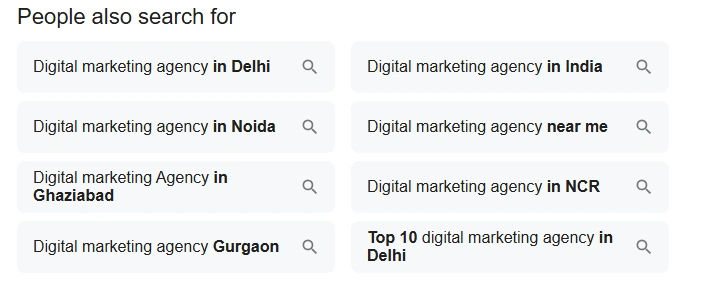
The People Also Search For (PASF) is an amazing Google SERP feature. This box appears on the results page after you click on the search result. The section displays a list of queries that people might be looking for that are relevant to your search.
Just think about this in a way – it’s Google’s way of saying “if you are interested in that, you might also want to know this”. Therefore, the “People Also Search For” box is a dynamic reflection of genuine curiosity, designed to help searchers find more specific information. Certainly, understanding and optimizing People Also Search For (PASF) is the first step for curating more resonant content.
Why Ranking on “People Also Search For” Is Important?
In simpler terms, ignoring the People Also Search For Section optimization is like leaving free organic traffic on the table. The importance of the PASF feature extends beyond just being another SERP feature. Here’s why it is important:
Unlocks New Traffic Avenues: Ranking on the People Also Search For query places the brand’s content directly in front of relevant users who have demonstrated clear intent. Consequently, it drives highly qualified traffic to pages that might not be ranking for the primary and other keywords.
Reveals User Intent & Content Gaps: The ‘People Also Search For’ is a goldmine for understanding the real intent of users. This PASF box shows the natural progression of a search session. It reveals the questions and subtopics that the brands might have missed including on their page – enabling you to build a comprehensive topical authority.
Enhances User Experience & Dwell Time: When you anticipate and answer a user’s follow-up questions within your content, they are more likely to stay on your site for a longer period. As a result, it reduces bounce rates and increases dwell time — sending a positive engagement signal to Google.
Secures Precious SERP Real Estate: Appearing in the PASF section means your listing appears twice on the same SERP. It may appear once in the organic results and once in the PASF box. Hence, it results in increasing your brand’s visibility, click-through rate, and overall digital footprint.
Why Ranking on “People Also Search For” Is Important?
Finding the “People Also Search For’ Keywords is quite a straightforward process. Here, the digital marketing companies and generally brands use an amalgamation of manual research and some powerful tools to build a strong list:
Google: The Direct Source
Generally, PASF keywords can be found on the result page, in user queries, and elsewhere. How can you find that? Here it is:
- Simply perform a search for your target keyword.
- Click on a competing result (not your own).
- Hit the back button to return to the SERP.
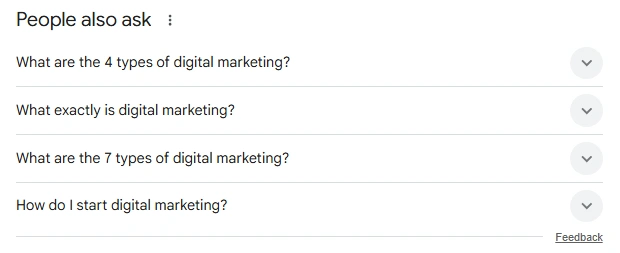
Voilà! The “People Also Search For” box will now be populated with fresh, related queries. You can also repeat this process for the new queries to uncover even deeper long-tail keywords.
Chrome Extensions:
There are multiple Chrome extensions available on Google which is very easy to use. You simply need to install, turn it on, and start using it. Here’s how?
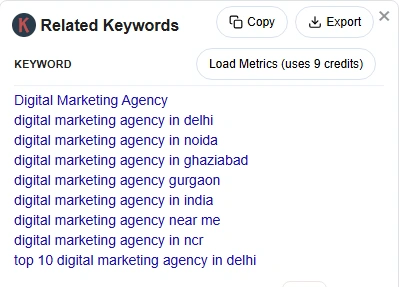
- Install a Chrome extension like “Keywords Everywhere,” “Uber Suggest,” or “SEO Minion.”
- These tools often automatically pull and display PASF data directly on the SERP as you browse.
SEMrush:
SEMrush proves to be one of the best tools for both keyword research and competitor research. Here’s how to use it:
- Enter your seed keyword.
- Look for the “SERP Features” column
- The column indicates features such as People Also Search For.
- Next, you can research your keyword from there.
Google Keyword Planner:
Next comes the Google Keyword Planner. It is proven to be a good keyword planning tool. However, it’s not easy to find the “People Also Search For” keywords here:
- It doesn’t show the PASF keywords directly, but it’s easy to find theme-based keyword ideas.
- Enter your primary keyword and analyze the “Keyword Ideas” it generates.
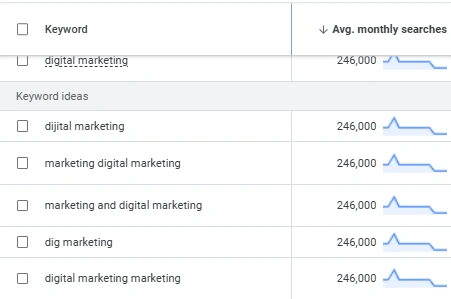
These are often closely related to the queries you would find in the People Also Search For section. Thus, giving you a broader content strategy perspective.
Ahrefs:
Ahrefs’ Keywords Explorer is a powerhouse for People Also Search For keywords. The SEO experts leverage this platform to find the most relevant keywords. Here’s how to use it:
- Input your target keyword
- Navigate to the “SERP” view or the “Parent Topic” section.
- You can also find data on “Also Rank For.”
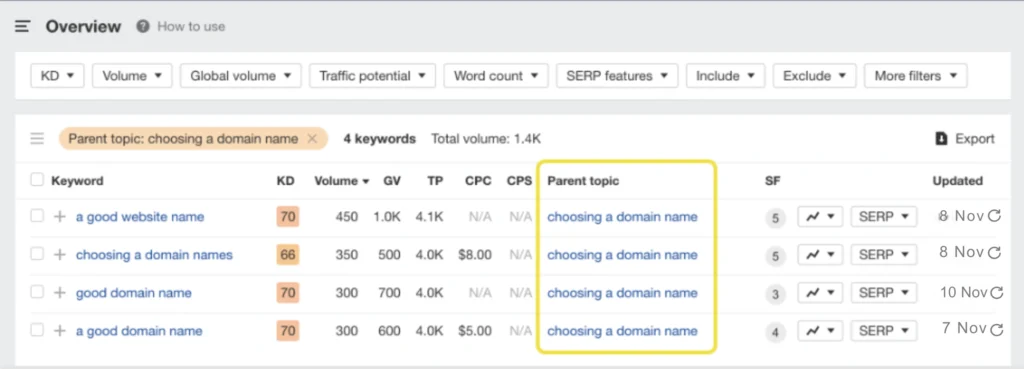
Most importantly, it shows you what other keywords the top-ranking pages are ranking for. Certainly, it provides a comprehensive analysis of potential People Also Search For topics.
How To Manage Duplicate PASF Topics?
As you research, you’ll notice that many People Also Search For queries are variations of the same core topic. In this case, creating a separate page for each can lead to keyword cannibalization. Here’s how to manage them effectively:
- Create Comprehensive Pillar Pages: Instead of writing five short articles on five related PASF queries, create one massive, ultimate guide (a pillar page) that covers them all.
- Use Internal Linking: Link strategically from your pillar page to more specific, standalone blog posts if the topic is substantial enough to warrant its own URL.
- Optimize for Semantic Relevance: Ensure your main content uses related keywords, synonyms, and context that naturally cover the intent behind the duplicate PASF topics.
- Leverage FAQ Sections: A well-structured FAQ section is a perfect place to directly answer the specific questions posed in the “People Also Search For” box without creating new pages.
- Conduct a Content Audit: Regularly audit your existing content to determine if you can merge thin pages covering similar PASF topics into a single, stronger piece of content.
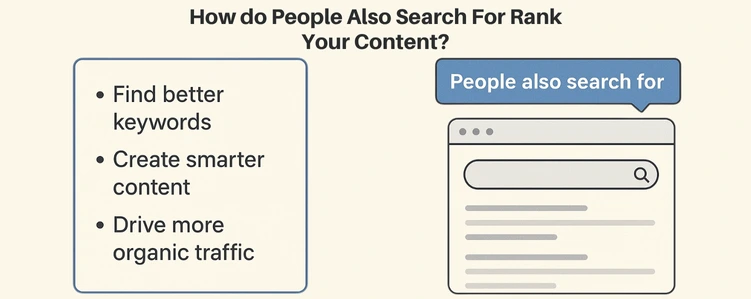
How do People Also Search For Rank Your Content?
Google’s algorithm for selecting content for the People Also Search For box is a closely guarded secret. However, we can infer the key ranking factors based on general SEO principles. Here’s How:
1. Topical Depth and Comprehensiveness
Google prefers content that thoroughly covers a topic. If your article on “email marketing” also seamlessly incorporates sections on “best email marketing software,” “email open rate benchmarks,” and “how to write a subject line,” you’re naturally answering common People Also Search For queries. This depth signals to Google that your page is a one-stop resource. Certainly, making it a prime candidate for the PASF section.
2. Semantic SEO and Contextual Relevance
Gone are the days of keyword stuffing. Google uses natural language processing to understand context. By using related terms, synonyms, and Latent Semantic Indexing (LSI) keywords naturally throughout your content, you align your page with the user’s broader search journey. Thus, this contextual relevance is crucial for appearing in related People Also Search For queries.
3. High-Quality Backlink Profile and Authority
While the content itself is paramount, Google also looks at domain-level trust. A website considered an authority in its niche, backed by a strong profile of high-quality backlinks, is more likely to be deemed a reliable source for the People Also Search For feature. In short, page authority reinforces the quality of your content.
4. Optimized Page Structure A well-structured page with clear headings (H1, H2, H3) acts as a roadmap for both users and Googlebot. It makes your page easily navigable and user-friendly. When you use these headings to pose common questions, “People Also Search For” queries. Subsequently, you make it incredibly easy for algorithms to understand what your content covers and match it to those related People Also Search for Google searches.
BRB Digital: Making Brands Appear in the People Also Search For Section
Navigating the nuances of “People Also Search For” and other SERP features like People Also Searched For can be complex. But, you don’t worry, your brand can easily appear on the “People Also Search For” box.
BRB Digital is one of the best digital marketing agencies. We specialize in crafting data-driven SEO strategies that put your brand in these desirable spots. Our SEO team begins the process with deep keyword research using an advanced people also search for tool to uncover every relevant query your audience is asking. Subsequently, we create comprehensive, user-focused content that satisfies search intent. A query that sends signals to Google that your page is the definitive answer.
So don’t think much! Let us help you not only rank, but also dominate the SERPs, including the powerful People Also Search For section. Contact BRB Digital today!
In conclusion, the “People Also Search For” feature is far more than a simple SERP curiosity. The PASF section is a direct line to your audience’s evolving questions and intent. By strategically integrating these related queries into your content, you transform your website from a static information source into a dynamic, user-centric resource. As a result, this approach not only captures valuable organic traffic but also builds undeniable topical authority. You should also consider the insights from the ‘People Also Search For’ and ‘People Also Asked’ boxes. Start treating them as the essential SEO tools they are, and watch your visibility and relevance soar to new heights.